About ten years ago, Gloria Akello, 35, went to Lacor Hospital for a general checkup. She wanted to test for cervical cancer and breast cancer. At the registration desk, the nurse who was recording patients’ details looked at her and said, “You are anaemic; you look very pale.”
Akello insisted that it was how she normally looked. The nurse checked her eyes and asked her to show her tongue, then insisted that she was anaemic.
When Akello finally saw the doctor, several blood tests were recommended, including a Pap smear for cervical cancer. When the results came back, she was found to be severely anaemic. Her hemoglobin level was 5, which is very low and dangerous. A healthy person’s hemoglobin should be between 12 and 16.
After seeing the results, the first recommendation was a blood transfusion. For personal reasons, Akello decided to seek a second opinion at another hospital. The second doctor reviewed the Lacor results but was not fully convinced and ordered another blood test. This time, her hemoglobin had dropped even further.
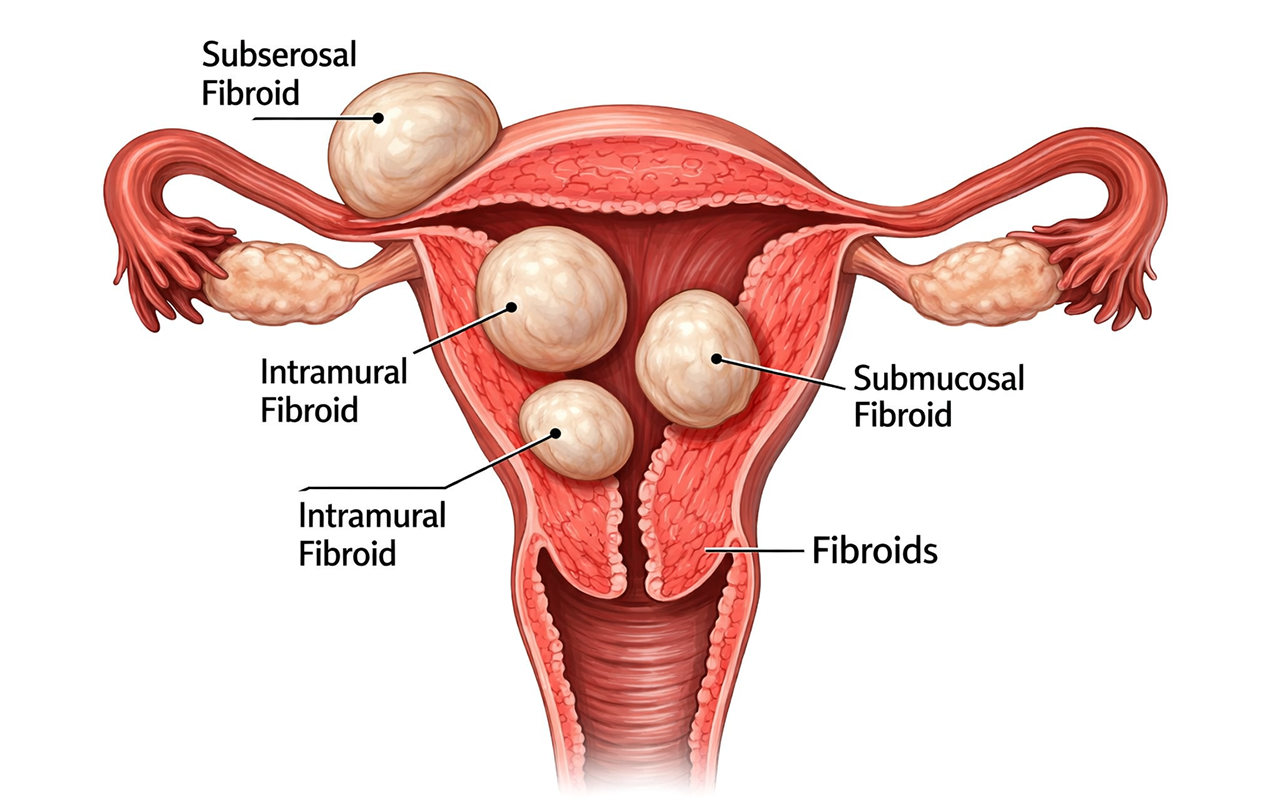
That is when the questions began, as the doctor tried to find out why she was losing so much blood. He later recommended a scan. The scan revealed that Akello had fibroids. They were still small but enough to cause heavy bleeding during her monthly periods.
For Linda Adongo, fibroids came silently in the form of growths in her uterus. She experienced no pain and no heavy bleeding, only the gradual growth of the fibroids until they became large enough for her to feel. “Every time I lay down, I would feel it moving,” she says.
Adongo did not become anaemic, but as the fibroids grew, her stomach enlarged and made her look pregnant. “Family members and friends kept asking me how many months pregnant I was,” she says. The questions embarrassed her and forced her to start wearing big clothes to hide her stomach.
Both Akello and Adongo were unmarried and childless when they discovered they had fibroids.
Hope Ageno, a mother of three, discovered she had fibroids after losing excessive blood during her monthly periods, which made her anaemic. In her family, fibroids are common. All her sisters have fibroids, and even her aunt, her mother’s sister, has them.
To understand what fibroids are, Dr. Adongakulu Emma Bongani, resident obstetrician and gynaecologist at Lacor Hospital, explains that fibroids are non-cancerous growths that develop in a woman’s uterus during her reproductive years. “Fibroids are what we call benign growths that happen in the uterus.”
“There are several hypotheses related to it. One, there is a hypothesis of persistent exposure of the uterus to the hormones, to those reproductive hormones, that is, progesterone and oestrogen.”
According to Dr Adongakulu, this mostly affects women who have never conceived and therefore have long-term exposure to oestrogen and progesterone. This continuous exposure can lead to the development of fibroids. Oestrogen and progesterone are two important hormones mainly produced by the ovaries, and they control the menstrual cycle, pregnancy, and changes during menopause. Oestrogen increases in the first half of the cycle to thicken the lining of the uterus and help release an egg (ovulation), while progesterone rises after ovulation to prepare the uterus for pregnancy. If pregnancy does not occur, progesterone levels fall, causing the uterus lining to shed, which leads to a menstrual period.
“It’s because these fibroids feed on the reproductive hormones. When you reach menopause, you no longer have these reproductive hormones, and they eventually also shrink.”
Dr. Adongakulu adds that this explains why it is rare to find women in menopause with fibroids, as the hormones that fuel their growth reduce.
Dr. Jolly Joe Lapat, the executive consultant at Anaka General Hospital, re-echoes and confirms Dr. Adongokulu’s explanation that fibroids occur only in women of reproductive age. Dr. Lapat explains that this is because, during this period, reproductive hormones are actively being secreted. He adds that after menopause, a woman cannot develop new fibroids.
Like many other conditions, fibroids cause women to display certain signs and experience symptoms. Dr. Lapat says that when fibroids grow big, a woman may start feeling heaviness in the pelvis, while others experience lower abdominal pain and lower back pain. He further explains that women with fibroids tend to bleed heavily during menstruation and can sometimes experience prolonged bleeding.
He adds that large fibroids can also affect fertility. “As a result, most women who have maybe large fibroids get issues, number one, with conception, have miscarriages and other pregnancy complications.”
Although fibroids are not cancerous, Dr. Lapat warns that they can indirectly lead to death if not treated early, mainly due to excessive bleeding that causes severe anaemia.
“It is when the symptoms become severe and are neglected, especially number one is bleeding. Yeah you can lose lots of blood and if it is not diagnosed early, you can just die because of anaemia but not because of the fibroid. Most of the deaths we have seen are mostly I think around that and the treatment. When it is complicated sometimes even the removal and other things causes a lot of blood loss,” he says.
When Akello’s hemoglobin (HB) level was found to be very low, the doctor recommended a blood transfusion because she was suffering from severe anemia. Hemoglobin concentration is one of the ways doctors measure the amount of blood in the body.
According to Dr. Lapat, when a fibroid is still small, doctors may not take immediate action apart from monitoring it to see whether it is increasing or reducing in size.
He adds that in some cases, patients are given medication.
“To reduce the symptoms, there are medications that can help reduce the size of the fibroid. They help a lot in reducing bleeding and other pain medications like Ibuprofen.”
According to Dr. Adongakulu, although fibroids can be treated either through medication or surgery, surgery is often preferred because of the side effects of some drugs. “We tend to prefer surgical over medicinal, because certain medical methods, certain medical avenues, or some of those drugs, induce menopause,” says Dr. Adongakulu.
He explains that some medications used to manage fibroids work by stopping the production of hormones that support fibroid growth. While effective, these drugs can push a woman into early menopause.
“When you stop the production of those primary hormones, in the long run, it leads to development of early menopause. So, in case we get a lady with fibroids who has a desire to give birth, we sometimes usually want to opt for the surgical aspect. We remove them surgically, and usually encourage you to conceive within a space of at least two years,” he says.
With advancing technology, some hospitals in Uganda have started using newer methods to shrink fibroids without open surgery. According to Dr. Adongakulu, a few facilities have already adopted these techniques.
“They can just go and make small incisions, and they use machines to block some of those blood vessels which are supplying the fibroids, and eventually the fibroids will shrink.”
However, Dr. Lapat cautions that uterine artery embolisation, where blood supply to fibroids is blocked is not suitable for all women, especially those who still want to have children.
“It is only used for people who are no longer desiring fertility because it will affect the entire uterus. So they are advanced but not good for people who are still desiring fertility.”
Although surgery is often preferred, it also carries risks. Dr Adongakulu explains that if surgery is not well executed, a patient may develop complications such as endometriosis.
Endometriosis is a painful condition in which tissue that is similar to the inner lining of the uterus grows outside the uterus. “If the fibroid has entered up to inside the uterus, inside the wall of the uterus, if it has been extracted, if the repair is not done well, you may find some of that tissue which is supposed to be inside the uterus being found within the wall or outside, which will also eventually cause people to experience painful periods later on in life,” Dr Adongakulu says.
He adds that when surgery is done properly, the risks are usually minimal. In cases where a woman has completed childbearing or has other serious complications, removing the uterus may be the best option, according to Dr. Adongakulu.
While doctors recommend medication and surgery, Aber Jackie, a senior pharmacognosist, offers a different approach by developing natural remedies for gynaecological conditions, including fibroids. She says she uses various herbal medicines to treat and shrink fibroids.
“We have different remedies that we use for fibroids, and what we know from natural therapies, those are a combination of so many phyto-components. So when we are trying to treat fibroids, that same drug also helps to treat other health conditions.”
According to Aber, the treatment comes in two forms oil and powder.
“We treat depending on what could be causing or what other health conditions related to reproductive health that particular lady could be having. Then once we have treated that, then we come to the fibroids. So we give you the oil and then the herbal powder therapies.”
The powder is mixed with water and taken orally, while the oil is applied on the body.
Sarah Adongo is one of the women who say they have benefited from Aber’s natural remedy treatment. About three years ago, Sarah started experiencing pelvic pain and had difficulty conceiving. She decided to seek medical help, which led her to get a scan.
“And up to now, I still don’t have a child of my own. So I was going to the scan, that’s when I discovered that I have fibroids. It reached a point where it started paining me now.”
She says the pain often occurred whenever she was sitting or bending down. After a recommendation from a friend, she visited Alpha Natural Remedy, where Aber prescribed herbal medicines with instructions to take them twice a day.
“In fact, it wasn’t even the drugs for the fibroids; it was herbal drugs for the stomach, and maybe you take. So we went there, and I saw those drugs. Then I decided, oh, I got interested. Then I said, let me try these drugs, they might help me with my fibroids.”
Sarah says that after taking the herbs and doing exercises, she went back for another medical check-up and was told by her doctor that the fibroids were no longer there. Even after the confirmation, she chose to continue with the herbal treatment.
“So I went back to her. I went her to ask for me more, because maybe they are still there, you can say that it’s gone, but they have just disappeared, but they can even come back anytime. So I took another one, and I’m taking it at the moment.”
Stella Laker, 60, discovered she had fibroids after visiting hospital for a checkup following persistent pelvic pain.
She says she was experiencing severe abdominal and lower back pain, which repeatedly sent her to hospital. During the process of scanning to find the cause of the pain, doctors discovered that she had fibroids.
Although the doctors identified the fibroids, she says she was never given any treatment or clear guidance.
“I wasn’t given any treatment. I wasn’t given any treatment. I was not advised on what to do. It was just there. So whenever there was pain, because the pain was not constant, it would come, go, come, go. So I was relying on painkillers.”
Laker says that when she later contacted Aber Jackie, she was asked to first send her scan report. After reviewing it, a treatment schedule was developed.
“I was actually on treatment. Because she gave me what is called a ‘cycle’ the first cycle of drugs. It would last about a month or a month and something, maybe a week or so.”
Aber explains that treatment for each client depends on how big the fibroids are. She says some patients need only one cycle, while others may require up to thee cycles. She explains that treatment depends on the size of the fibroids and can take between two and six months.
“I give them each month a combination of different packages. So I give them for three months. And after the third month, I send them back for a scan because our Centre still doesn’t have a scan. I send them back for the scan, then they bring for me the results. Then together with the patient, we discuss and I explain to them what is happening”.
Laker says that after completing the first cycle, Aber Jackie advised her to go for another scan before starting the second cycle.
“Actually after the first cycle, she advised that I go and do a scan. Yes, I went and did a scan again and found it had reduced.”
She adds that immediately after starting the natural remedy drug combination, she experienced relief from both lower back and abdominal pain.
While on treatment, Laker says Aber also advised her on what foods to eat and avoid.
“When I contacted her with the fibroids, the advice she gave me, she told me to stop taking sugar, red meat, things like that.”
Although fibroids are common, only Health Centre IVs (sub district or county hospitals) and hospitals with operating theatres can perform fibroid operations. For women in rural areas, this often means referral to bigger facilities.
Layette Alice, an enrolled midwife at Pabbo Health Center III in Amuru District, says they receive at least five or more women every quarter with signs of fibroids, but they can only record their history and refer them.
“The only thing we can only do is the history, history taking, and then we do the referral. Then at times, if the mother comes, like with those signs and symptoms, definitely we query many things. At times, we end up doing palpation, we do pregnancy test. At times also, we end up doing the cervical cancer screening. Then after that, we refer them. That’s where we stop. Here, we don’t have a theatre.”
According to Dr. Lapat, access to ultrasound scans remains a major challenge for many women in Uganda, yet scans are critical in detecting fibroids.
He explains that access to scanning services largely depends on the level of the health facility.
“Right now scans in the Ugandan system, if you’re lucky, you’ll start getting it from a health center, for the lower facilities do not have ultrasound scans. But majority you’ll get either from a general hospital or a regional referral.”
Dr. Lapat says limited access to radiology services continues to affect early diagnosis.
On the cost of treatment, Dr. explains that fibroid treatment in government health facilities is meant to be free but that in private health facilities, the cost varies depending on the level of care and the institution.
“In private practice, I think the charges depend on the level and then the organization. I don’t know the exact value, but the cost of a single operation cannot be less than 500,000(138 dollars).”
He adds that in private clinics within urban cities and towns, prices are even higher.
“In private clinics here in town (Gulu City), the minimum is usually 1.5 million (415$). That is uncomplicated ones.”
According to him, the cost increases significantly in Kampala.
“But in Kampala (capital city) it can go as much as even 3.5 or 5 million (1000-1500$).”
Diet and Fibroids: What Food Can and Cannot Do
When a woman is diagnosed with fibroids, one of the first questions she asks is about food what to eat and what to avoid. According to a Sarah Among a nutritionist at Lacor Hospital, diet plays an important role, but it should not be misunderstood as a cure.
“So, diet is not a treatment for fibroids, but it’s a supportive measure. It’s not a cure. The cure for fibroids, medication is given, and the surgical intervention is made,” the expert explains.
“Diet, however, can help manage the symptoms that come with fibroids, such as pelvic pain and heavy menstrual bleeding.”
Foods to Limit When You Have Fibroids
She says that women suffering from fibroids should limit processed food like junk foods such as sausages, chips, and other highly refined products because such foods tend to increase inflammation.
“So, this processed food increases inflammation, meaning that the person that has fibroids will have more pelvic pain when they consume processed food.”
Among further adds the second category to limit is red meat.
“So, red meat is meats found in mammals, like cattle that’s beef the sheep, and pork. This is meat which is red prior to cooking like processed foods, red meat can worsen fibroid symptoms.”
However, Among notes an important balance, especially for women who bleed heavily. She says although meat is a good source of iron for a women having heavy menstruations, there are other sources of iron that can help without increasing inflammation.
“We have liver, which is another good source of iron, but it’s not red meat. And then also, we can get our iron from vegetables from fruits like hibiscus.”
She also says that high fat dairy products like milk, sugar, and refined carbohydrates should be reduced.
Among emphasises that diet cannot cure fibroids but helps the body cope better, like food containing fibre, whole grains, fruits and vegetables, whole grains, especially those that are not refined.
She says that eating more fibre rich foods, whole grains, fruits, and vegetables while limiting processed foods, red meat, high-fat dairy, sugar, and refined carbohydrates can help reduce pain and heavy bleeding making life with fibroids more manageable as women seek proper medical care.